
FAQ about Revos concentration system
Technology and process
How do you measure alcohol concentration when using the Revos concentration system?
Alcohol concentration is measured continuously using liquid density and refractive index. These parameters are combined using a proprietary calculation model to deliver real-time alcohol-by-volume (ABV) measurements.
What is the maximum achievable alcohol concentration? Can alcohol levels as high as 70% ABV be achieved for other beverages by adding an additional membrane?
The standard system produces beer concentrate up to 22% ABV. This limit is influenced by safety requirements, ATEX compliance, installation constraints, and local regulations.
Higher concentration ranges and other beverage applications are under technical evaluation. No maximum ABV above 22% ABV has been defined yet.
What is the smallest available system capacity?
The smallest Revos concentration system has a throughput of 6 hl/h.
How long does it take to reach maximum concentration?
The Revos concentration system operates continuously. A 6hl/h system typically reaches steady-state operation in 90–120 minutes after start-up.
Is the concentrated product filled into kegs or bag-in-boxes (BIBs) using an Alfa Laval Astepo system?
Concentrated beer is typically filled into kegs to preserve carbonation. Bag-in-box (BIB) packaging is not suitable due to the concentrate’s CO₂ content.
Kegs allow brewers to use existing infrastructure while maintaining beer quality and performance at the point of dispense. Where appropriate, the concentrate can also be transported in bulk formats.
Product and quality
Is the beer completely free of CO2 after reverse osmosis? How is carbonation restored?
Loss of CO2 during concentration is minimal, resulting in a slightly lower carbonation level compared to the original beer. Full carbonation is restored during concentrate reconstitution:
- For draft dispense systems: The concentrate is blended with water and carbonated inline at the point of dispense using an integrated carbonator, ensuring the final beer meets the desired sensory and carbonation specifications.
- For bulk transport applications: The concentrate is reconstituted and carbonated upstream – before bottling, canning, or kegging – using solutions such as the Alfa Laval Carboblend (inline carbonation) and Alfa Laval Alfadose (accurate dosing and blending), which support the consistent and controlled reconstitution of the final product.
How is water quality ensured when reconstituting beer concentrate in pubs?
Draft dispense systems use a 5-micron carbon filter on the feed water line to remove odours and particulates. This level of treatment is sufficient for most municipal water supplies.
In areas with hard water or high total dissolved solids (TDS), an under-the-counter ion exchange unit and/or a reverse osmosis water purification unit may be required.
Draft dispense system
Is it possible to convert the draft dispense system to 50 Hz?
No, conversion is required. The draft dispense system is available in 50 Hz and 60 Hz configurations.
Can multiple beer brands be produced from the same keg (mother beer) using different blending ratios?
Yes, it is possible to produce multiple beer brands with different final ABV levels from the same concentrated mother beer by adjusting the regulating valve to set blending ratios in advance.
Each brand requires its own tap tower and separate concentrate keg.
Regulating valves are sealed and secured to prevent unauthorized manipulation during dispensing
Can a single draft dispense system serve multiple products?
Yes. Each brand uses a dedicated tap and blending unit to maintain fixed ratios and consistent quality.
Is the draft dispense system available now? What’s the cost to install a unit?
Draft dispense test units are currently available for rental, and commercial-scale prototypes are available for order. Pricing and installation costs vary by configuration; quotations are available upon request.
Draft dispense requires changes to the supply chain. Where does a draft dispense system make the most sense?
Draft dispense systems are best suited for brewers who own or manage their draft equipment or maintain close relationships with venues serving draft beer.
Reconstituting beer from concentrate reduces the number of kegs required on site, saving space and reducing both keg investment and the risk of keg loss. Existing draft stations can be retrofitted without requiring replacement, enabling a smooth transition with minimal operational disruption.
Installation and operation
What is the Cleaning-in-Place (CIP) cycle for the Revos concentration system?
The system undergoes a full CIP cycle after each concentration batch, including caustic cleaning at approximately pH 11.5. A typical CIP cycle takes about four hours.
What is the typical timeframe for membrane replacement?
The recommended interval for membrane replacement is nine to 12 months, depending primarily on CIP frequency.
Can the Revos concentration system be used in a mobile operation?
No. The system is designed for fixed installations and requires substantial utilities, supply connections, and site-specific engineering.
Are the dimensions of the Revos concentration system suitable for skid or truck mounting?
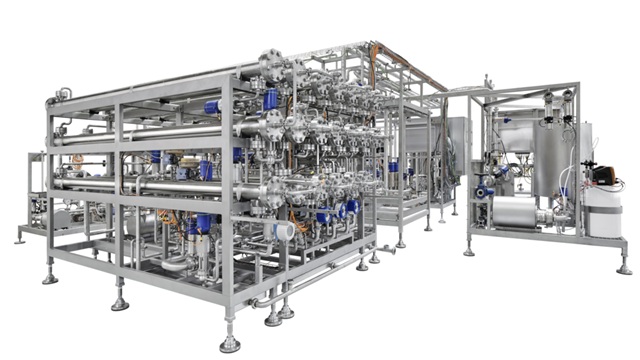
The system is delivered as a modular installation on four skids, simplifying transportation and on-site logistics. It can also be containerized for efficient shipping and installation.
While the skid-based design facilitates transport and installation, the system is intended for permanent, fixed installation and is not intended for truck-mounted or mobile operation.
How many people are required to operate the Revos concentration system?
The system is fully automated. One operator is required to start and supervise the operation. Membrane replacement, typically every 9 to 12 months, requires two people.
How many people are required to install the Revos concentration system?
Installation typically involves multiple teams, covering mechanical assembly, electrical installation, and pipework. Alfa Laval can coordinate and supervise installation and commissioning.
Are there any issues with foam generation in the Revos concentration system? If so, how is it managed?
The system operates in a continuous mode without recirculation, which minimizes conditions that typically lead to foam formation. Under normal operating conditions, foaming is not expected. The process is designed to maintain stable flow and pressure throughout the system, thereby reducing the risk of CO₂ release and foam generation.
Utilities and safety
What are the ATEX considerations when concentrating beer with an alcohol content above 22%?
For European installations, ATEX requirements are assessed on a case-by-case basis. When liquids are fully enclosed within the system, and the alcohol concentration does not exceed 22% ABV, a potentially explosive atmosphere is not expected under normal operating conditions. As a result, ATEX-rated components are typically not required.
Final requirements are determined through a documented ATEX risk assessment, which covers installation, operation, maintenance, abnormal conditions, and applicable local regulations and governing authority requirements.
In general, what peripherals are required?
The system requires warm water at 40°C for Cleaning-in-Place, deaerated water for flushing, electricity, and compressed air for valve operation. If warm water is not available on site, a steam supply is required to heat cold water.
What type of water is required for reconstitution, and are brewing salts lost?
For the reconstitution of beer concentrate, Alfa Laval recommends using low-total dissolved solids (TDS) water, typically 1- 100 mg/L, similar to water used for high-gravity beer dilution. The Revos concentration system removes only water; all brewing salts remain in the concentrate.
What is the energy consumption of the system?
Typical energy consumption is approximately 1 kWh per hectolitre (hl) of beer processed.
Commercial
Is there a real business case that you can share? Can you provide a complete overview of the savings achieved?
Customer-specific business cases cannot be shared publicly at this time. However, as a general reference, the total cost of using a Revos concentration system – including amortized capital costs – is approximately 1–2 EUR/hl at sales gravity. Costs for larger installations generally lie at the lower end of this range.
Savings are mainly driven by reduced transportation costs and therefore depend on the logistics setup. For example:
- If bulk transport costs are around 10 EUR/hl, the use of a Revos concentration system may reduce them by approximately 6.6 EUR/hl.
- In draft dispense applications, savings are often higher. Transporting finished beer typically costs around 20 EUR/ hl. When transporting beer concentrate, these costs can be reduced by up to 16 EUR/hl, a savings of up to 80%.
Percentage transport savings are generally greater for draft dispense applications, as bulk transport is often already performed at high gravity.
Do you have operating expenses (OPEX) for the Revos concentration system? Can these be compared with competitors’ technologies?
Typical operating expenses for the Revos concentration system range from 0.5 EUR/hl to 1 EUR/hl. While Alfa Laval does not have verified OPEX data for competitors’ technologies, it is important to note that the system does not rely on evaporation or freezing – offering a significant advantage in energy efficiency.
Do you have an indicative installation cost?
Installation costs vary, depending on site conditions and system configuration. Quotations are available upon request.
What is the maturity level of readiness of this technology?
The Revos concentration system is commercially available and has been deployed in the field, with the first units currently operating in Asia.
What is the rental price for the 6 hl/h Revos concentration system?
Rental pricing depends on project scope and duration. Quotations are available upon request.
Revosで実現するCO2削減 - 詳細資料
醸造所や飲料製造施設は、どのようにすれば、カーボンフットプリントと業務効率を両立できるでしょうか? 原材料の購入、電力、製造から包装、材料、流通に至るまで、直接・間接排出の削減は重要な役割を担っています。この資料では、メーカーによるサプライチェーンの二酸化炭素排出量を削減するための費用対効果の高い方法として、ビールや飲料濃縮用の逆浸透(RO)膜ろ過に焦点を当てます。